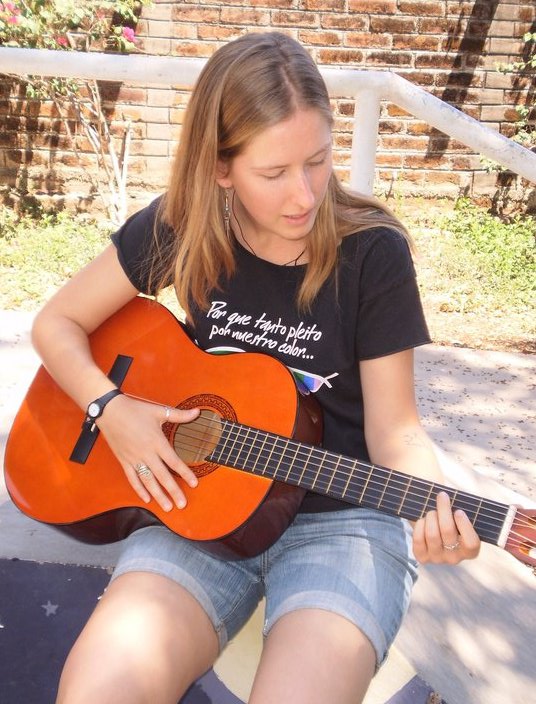
Hi folks - this is primarily just to say that there are more photos up at my picasa space: http://picasaweb.google.com/foggytechtor. Enjoy! I graduated last night, so I have a few from the dinner and then a couple from my trip to the market this morning. (Really these are just the photos of the multicolored chicks.)
Showing posts with label PLQ. Show all posts
Saturday, July 17, 2010
More photos!
Hi folks - this is primarily just to say that there are more photos up at my picasa space: http://picasaweb.google.com/foggytechtor. Enjoy! I graduated last night, so I have a few from the dinner and then a couple from my trip to the market this morning. (Really these are just the photos of the multicolored chicks.)
Thursday, July 15, 2010
Endings (of beginnings?)
I am sadder than I expected about the prospect of finishing up at PLQ. I shouldn't be surprised - I was only going to be here four weeks and have already extended by two whole weeks. PLQ is just such a special place to be. Wonderful people, phenomenal community fostered by the school, SUCH quality education (both Spanish and about the history, culture, current realities of Guatemala). I'm also loving living in la Casa de las Amigas with four other great women from all over the US. I've really enjoyed living in this type of community for the last couple of weeks. (Living with a host family is great, but I have loved the Casa.)
It is bizarre being so close to wrapping up the first stage of my journey. Admittedly, it is the shorter part, but it seemed like such a wide buffer between me and El Salvador - and now it's almost finished! I've more or less known I was going to go back to Salvador since I returned from my semester in December of 2008. I didn't always know how this was going to happen, but one way or another, I knew I wanted to return. The fact that I'm so close now to going is whacky (and so exciting!).
Last night the movie-and-hot-chocolate-night selection was Voces Inocentes, a movie I had seen before and can HIGHLY recommend. I follows a little boy and his family during the civil war in El Salvador and shows the effects the war has on their daily life. It is an intense, powerful film that does include some violence against kids, so that's something to know going in. But still incredible.
Friday, July 9, 2010
New photos - Salcaja

These are the photos from Wednesday's trip to the town of Salcaja, about half an hour from Xela. We visited a "campo de textiles" (literally a textile field). The folks in Salcaja weave a very specific kind of cloth that does now pertain to any specific ethnic group in Guatemala - something of a national semi-indigenous (though based on some Spanish methods) weaving tradition. Very interesting. The gentleman in the first photos took time off from his day to show us a bit of the process. The woman in purple and I interpreted (ha!) for him. Daunting, but doable. (And no, my Spanish is not anywhere near the point where I should be interpreting things.) The field is the only place in town long enough to set up the process, so they weave outside in a community setting rather than in individual houses.
We then visited the oldest church in Central America, La Ermite de la Virgen de la Concepcion la Conquistadora (the Hermitage of the Virgin of the Conception the Conqueror). It was built in 1524 and the altar is original. (The kind of freaky Virgin doll is decidedly not, in my estimation.) It was incredibly interesting being there after having spent the last four years partly in a program looking at colonization and the last five weeks immersing myself in a highly colonized atmosphere (though not so much more than our own - perhaps less in some ways). There's a lot to repent, that's for sure.
Finally, we went to a home brew place where a very local drink called Caldo de Fruitas (Fruit Soup) is made. Not my favorite drink - very sweet and fruity, shocker. But the family is also involved in the weaving process, so the man in the later photos demonstrated for us for a couple minutes.
Yesterday, we had an incredible conference on migration and globalization. The presenter in an incredibly astute, savvy ex-immigrant who "deported himself" back to Guatemala a couple years ago in order to work with youth here who "think that the US is the best place in the world" - so that they know the full reality of what they take on if they leave. And more importantly, to try to develop programs for deportees and a form of alternative economy that could prevent so many people from having to leave in the first place. One of the communities he works with here is a place we visited when I was here with CGE and is well worth a plug: the community of Santa Anita la Union, made up of 36 families in which the parents are ex-guerrilla combatants. It is a truly special community and it was really a privilege to hear our presenter's story. I don't have my notes right this second and I want my post on the conference to do it justice, so it will have to wait, but it is coming.
I am going to be studying in PLQ another week as well, which I'm thrilled about.
Monday, July 5, 2010
The Revolution Will Not Be...
PLQ shows a documentary each week on Monday, usually something about the history of Latin America, colonization, or popular movements around the world. Today´s film was The Revolution Will Not Be Televised, about the 2002 coup d´etat in Venezuela (and the subsequent re-instatement of the Chavez government).
Now I have to say, I am no great fan of Chavez and think that, in the years following the coup especially, his approaches to press freedom and endless re-election have become very problematic. But that didn´t stop me from sitting on the verge of tears when we watched him leaving the presidential palace, while refusing to resign, in order to keep the military from bombing the palace with people inside. This made me realize a couple of things: 1) I watch too much West Wing. The camera crew (which was there for a simple documentary about Chavez´s popularity among the people when the coup occurred) had extraordinary access to the halls of power, so it was (in a dorky way) very much like watching a certain tv show about the presidency. 2) I hadn´t realized just how much I had believed over the past year that something like that could have happened in the States. Not likely, perhaps, but the fear was there. The opposition rallies looked so much like Tea Party rallies, with their vitriol and ¨populism.¨ I hadn´t noticed this fear before, but it was clearly there.
Another crucial aspect was the collusion between the high-ranking military officials and the media. At one point, AFTER Chavez´s ministers had retaken the palace and the guard on site was clearly supporting them, the ¨provisional president¨ (from the coup) told CNN that everything was under control - a few angry, violent Chavez supporters outside the gates, but all in order otherwise. And since the state channel had been cut, there was literally no way to get the word out to military bases in other parts of the country that Chavez had never resigned and that the soldiers (not to mention the people in general) had been lied to. A good reminder to read with a skeptical eye what we receive via any media source (except the MetroLutheran, of course) and determine who benefits from which sources´ explanations.
In brief (ha!) I highly recommend this documentary. I might not be in line with everything Chavez does, but it is absolutely worth a watch.
Labels:
authoritarianism,
elections,
PLQ,
solidarity,
United States,
violence
Saturday, July 3, 2010
Back from the Mountain (School)
Just another quick update to inform that I'm back from the Mountain School and glad to be in Xela again. I love the mountain, but it is a bit difficult, especially in the rain. (And there was an awful lot of rain.) Because so much of the surrounding area is privately-owned land, it is difficult to go out and about, given the proclivity of some folks to hire armed guards (much like the McDonald's here in Xela). BUT - I finally got some photos uploaded from my camera, courtesy of Lauren's cable, so here we go - an attempt at putting photos on the blog.
[Alas, no luck this time. But I can just send you toward my newly uploaded picasa collection: http://picasaweb.google.com/foggytechtor/Guatemala2010?authkey=Gv1sRgCOuGruPf5O_PLQ# ] Enjoy!
[Alas, no luck this time. But I can just send you toward my newly uploaded picasa collection: http://picasaweb.google.com/foggytechtor/Guatemala2010?authkey=Gv1sRgCOuGruPf5O_PLQ# ] Enjoy!
Saturday, June 26, 2010
Off to the Mountain!
Just a brief update to explain an upcoming absence: I'm heading out tomorrow morning to La Escuela de la MontaƱa, the rural school run by PLQ. As of a couple weeks ago, they didn't have any spaces at all in July, but when I asked again yesterday (without much hope of things having changed), there was a space! So I am able to head up there to study for a week amid two communities of people who formerly worked as glorified slaves on coffee fincas, as well as among the mountain trees, animals, and coffee. (I am pretty damn excited about the coffee, I must admit.)
The Mountain School has a capacity of 14 students, so it is very laid back and remote. All of the students live on the school grounds in the same building and share a communal kitchen. But for the official meals, we go into the neighboring communities to eat with families. [Many of the families in these communities are poorer than folks in Xela and would have a hard time actually putting up students full-time, but the school wants to include a homestay-type experience, as well as supporting the communities' projects.]
I'm working right now on a loose translation of "Those Three Are on My Mind" for graduation in a couple of weeks. For some reason, the assassination of the three SNCC workers keeps coming to mind as an event from our own history that can touch my memory in at least a similar way that the war here does.
Tuesday, June 22, 2010
Cruzando
I was talking with someone at school here today. He's a Guatemalteco and his sister is in the States. Somehow our discussion of reciprocal verbs morphed into a conversation about his sister's experience crossing the Mexico-Guatemala border, the entire country of Mexico, and then the US-Mexico border. It's a harrowing story and although I certainly wasn't taking notes, I want to retell it as best I can.
After deciding to leave, the sister and her son (16 years old) first had to cross the border into Mexico. Because I was planning to go into Mexico for a couple of weeks myself, and didn't because of the level of danger there, I know at least theoretically how many ways there are to get oneself hurt in that part of the journey. In Mexico, they found a coyote who would take them in a truck. The set-up was this: Think of the inside of a U-haul-sized truck with a false wall about a foot inside each real wall. It's in between these walls that they stood - for 24 hours, driving through a sweltering desert. Because another passenger's knee spent the whole time pressed against the son's knee, when they got out shortly before the US-Mexico border, his knee was the size of a small watermelon. And the next step was to walk through the rest of the desert and cross on foot.
They tried this at Juarez (the most dangerous city in the Western Hemisphere, especially for women) and were detained by La Migra (immigration) and taken back to Mexico City. From there they made the journey once again to a point just south of Juarez and tried again. Once again they were captured and this time detained in a prison along with narcotraffickers and gang members - as though they were violent criminals.
Once they got out, they tried again, but this time going into California. It was a 15-day walk through the desert, without shoes. At one point, the mother (ie, my friend's sister) fell off an 8-foot ledge and injured her own leg. So whereas she had been supporting the son, now they had to walk holding onto each other and each supporting the other. [As a side note: the Mexico trip I referred to last time included a trip 100 km into the desert on the Mexico side. It is utterly brutal and if you want any chance of escaping La Migra, you have to walk through literally a carpet of cactus.] Five days out from their crossing point, they ran out of water and had to drink water with mosquito larvae, filtered only through their shirts, and they got sick.
When they finally crossed into California, they were given $5 by their coyote to buy some food at McDonald's, but they couldn't keep it down, since they hadn't eaten in days. And the $5 might sounds kind, but in comparison to the Q60,000 ($8500) that they now owed to the coyote....
They had to spend several nights in a park in LA, waiting for family in Texas to drive and pick them up. My friend told me that before leaving, his nephew had been a weightlifter. Not a body builder, per se, but fit and strong. By the time they got to Texas, he was gaunt and had to stay in bed for 15 days just to recuperate his strength and heal his knee.
The mother and son now work together as janitors in two different establishments - a clothing retail shop and an apartment building. They work one job from 3am-8am, then the other from 2pm-10pm. (Notice that neither of those time slots offer quite enough time for a solid rest.) They hope that if they stay in the States another five years that they will be able to go home.
I offer this story (as something of a re-gift, as I feel privileged to have heard it the first time) as one of so, so many almost-identical stories of crossing. About 750 Salvadorans alone leave each day for the US and something like 400 are turned away or deported. The difference - the 350-ish people - don't all make it, though. The desert is littered with dead people who died in the attempt, starved, dehydrated, killed by gangs, etc. What would compel someone to do that? I am pretty sure it is not an interest in taking US jobs or getting rich and not paying taxes. (For the record, most folks in the States without papers never see a cent of the money that is taken out of their pay - they put in, but they don't receive anything in the form of social security and they aren't eligible for other welfare programs.)
So then a second thing: I miss my sister a whole lot. And I've only been gone two and a half weeks. My friend may, if they make enough, see his sister and nephew in five years, after a couple years already. What a context I come from that I can be upset about a one-year separation not even three weeks in! [Another side note: I just, while writing this, paused and had a conversation with another student here about different degrees of emotion and the fact that, while my experience of separation might exist within a completely different scale than my friend's, it is not less valid. In fact, trying to suppress it out of some sense of privilege-guilt tends to serve more to close dialogue than to open it.]
All of this is toward this point, I suppose: Next time the immigration situation in the US is frustrating, next time it seems that wages are being suppressed because of immigration, next time someone who gives you "reasonable suspicion" to doubt their status is frustrating on a personal level, please think about the situations that lead people to come here. Think on the separation of families and the debt and danger of crossing. Give people a story, even if it is your own fabrication, that is empathetic, understanding that we are all children of the same God and that God could care less about la frontera, except as it crosses and endangers the lives of Her children.
Thursday, June 17, 2010
A puzzle of luck
There are some really wonderful people at Proyecto Linguistico right now. A great community of people, several of whom started and will end at the same time as I did/will. There is also a group here from Newman University in Kansas. They're here as part of a summer language program. I've gotten to know a few of them over the last week or so, as well as their professor/coordinator. She and I have been swapping some ideas about how to enrich and broaden the abroad experience for more students. In the course of these conversations, I've realized just how many opportunities I've had - mostly fluke occurrences - to spend time among amazing people in amazing contexts. (And, I should say, all of these have come by way of the truly fantastic people I grew up surround by. I can't think of any of the great chances I've had that were not handed directly to me, or at least sent quite directly my way, by an adult I already knew.)
Starting with the Mexico-US border in 8th grade (through Holy Trinity), then South Africa (courtesy of Tom Witt), Heifer International (again though HT folks both times), the Rolling to Overcome Poverty Bus Tour (via Sojos/CTR connections), and finally my phenomenal experience with CGE (through a whole handful of people).
I am so indebted to the people and communities who have allowed me to see what I have seen and meet the people I have met. The only way I can imagine digging myself out of that debt is to pass along the gift (an appropriately Heifer-ian notion). I joke about being evangelical about CGE's programs. But in reality, it is (at least subconsciously, up til now) my way of trying to strike while the iron is hot in the same way that others have caught me at just the right moment. I know that not everyone will have the opportunity or the interest when it comes to programs like this (and I also know that such programs don't have to happen outside of one's home place!), but as much as I can, I want to pass that gift.
Xela continues to be spectacular. My teacher this week is absolutely amazing - both as a human and as a teacher. I am learning so much! Yesterday a group of us visited the town of San Pedro Almolonga, a pueblito about half an hour from Xela with a complex of hot volcanic baths. Sooooo very nice and relaxing. And on the way there, we got off the bus about a 25-minute walk early and walked through town. It was the first time I have ever seen the Guatemalan campo from that angle. We were in the middle of fields, but surrounded by mountains and fog on all sides. Amazing (and it reminded me a bit of the scene in Mulan where they sing "A Girl Worth Fighting For," but probably only Ella will appreciate that). Then last night we had our weekly movie night at school and watched The Mission. (Wow. That's pretty much all I've got at this point on that. Oh! But Daniel Berrigan is in it? What?)
Saturday, June 12, 2010
Un caminata
El Mundial (the World Cup) has started and its effects are felt in full force here in Xela. This morning before going on a hike put on by our school, three of us went out for breakfast. At 7am, the restaurant we went to had the game on not one, but two screens, one of them almost wall sized. While I don't follow futbol (and, I must admit, prefer watching American football), I do enjoy watching games when they're available. So I can't quite get into the gripped place that many here are experiencing, but I definitely respect it.
The hike itself was spectacular. Five of us students went with two teachers from our school, both of whom were involved in the guerrilla in various ways. One was based in the city in a non-armed role. The other had been a combatant in the very area we were hiking in. Our intended destination was a former guerrilla encampment in which he had lived, at various times (it was a temporary camp), throughout the early 1990s. He entered the guerrilla when he was younger than Ella or I are now, because he saw all other options exhausted.
He talked about life as a guerrilla combatant, both in that camp and in general. He said that it is important to remember that was is not a game and is not to be entered into lightly, without trying every other possible outcome first. We seven stood on hallowed ground - ground on which people had died trying to bring about a better existence (no, not just an existence, but a life) for their communities and all of their compatriots. They would rotate one-hour shifts as the night watchperson. They carried bags of 50 to 100 pounds with them everywhere, in the sun, in the rain, through the mountains, and on 'paths' much narrower than the (narrow!) ones we used this morning.
[One thing I learned this morning was that I would have made a terrible guerrillera. Though I said this and the other teacher told me, "Con practica...", as in, 'it took everyone some time to get good at it; you'd figure it out.' I still think I would be awful, but it was good of him to say that.]
The main teacher who led us knew the area like the back of his hand. When we went back up (and down, and up - we had gone down through a valley), he had another student act as the guide. But any time we needed to be pointed in the right direction -- and we went up a different way than we went into the valley -- he was able to tell us exactly where we were and how to get up to the highway.
The main point the teacher wanted to drive home was the importance of using one's experiences to re-commit oneself to the struggle for justice, in whatever form one enters that current. (It's interesting, the word that folks here use to describe joining the guerrilla seems to be a lot deeper than just 'joining' something like a club. It is more toward a complete devotion of oneself, with intention; turning over one's whole being to a larger cause. Not so much in a mob mentality sort of way, but with great concern for others as well as oneself.)
The first Friday night graduation celebration of my time at PLQ was last night. It's always a blast. We sing, we eat, we dance, we drink, we celebrate the teachers and the students. Lot's of fun all around. It is one of the many, many things I love about this particular school. (And if anyone is looking to attend a Spanish school, I would HIGHLY recommend PLQ to you. Folks here now who have been to other schools can't stop marveling at how connected the students are, even though most of us are traveling on our own, and how much the school encourages us to deepen our experience and learning through the activities they put on.) I can't believe that a whole week has gone by of my four short weeks here.
Subscribe to:
Posts (Atom)