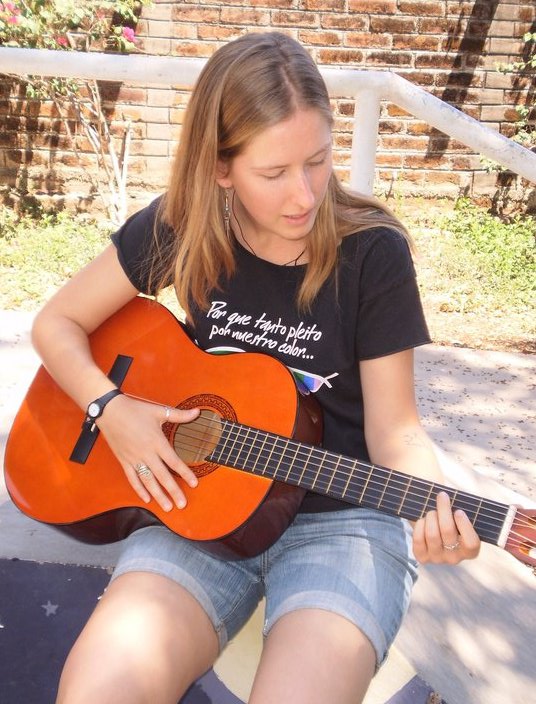
Hi folks - this is primarily just to say that there are more photos up at my picasa space: http://picasaweb.google.com/foggytechtor. Enjoy! I graduated last night, so I have a few from the dinner and then a couple from my trip to the market this morning. (Really these are just the photos of the multicolored chicks.)
Showing posts with label Xela. Show all posts
Saturday, July 17, 2010
More photos!
Hi folks - this is primarily just to say that there are more photos up at my picasa space: http://picasaweb.google.com/foggytechtor. Enjoy! I graduated last night, so I have a few from the dinner and then a couple from my trip to the market this morning. (Really these are just the photos of the multicolored chicks.)
Thursday, July 15, 2010
Endings (of beginnings?)
I am sadder than I expected about the prospect of finishing up at PLQ. I shouldn't be surprised - I was only going to be here four weeks and have already extended by two whole weeks. PLQ is just such a special place to be. Wonderful people, phenomenal community fostered by the school, SUCH quality education (both Spanish and about the history, culture, current realities of Guatemala). I'm also loving living in la Casa de las Amigas with four other great women from all over the US. I've really enjoyed living in this type of community for the last couple of weeks. (Living with a host family is great, but I have loved the Casa.)
It is bizarre being so close to wrapping up the first stage of my journey. Admittedly, it is the shorter part, but it seemed like such a wide buffer between me and El Salvador - and now it's almost finished! I've more or less known I was going to go back to Salvador since I returned from my semester in December of 2008. I didn't always know how this was going to happen, but one way or another, I knew I wanted to return. The fact that I'm so close now to going is whacky (and so exciting!).
Last night the movie-and-hot-chocolate-night selection was Voces Inocentes, a movie I had seen before and can HIGHLY recommend. I follows a little boy and his family during the civil war in El Salvador and shows the effects the war has on their daily life. It is an intense, powerful film that does include some violence against kids, so that's something to know going in. But still incredible.
Saturday, July 3, 2010
Back from the Mountain (School)
Just another quick update to inform that I'm back from the Mountain School and glad to be in Xela again. I love the mountain, but it is a bit difficult, especially in the rain. (And there was an awful lot of rain.) Because so much of the surrounding area is privately-owned land, it is difficult to go out and about, given the proclivity of some folks to hire armed guards (much like the McDonald's here in Xela). BUT - I finally got some photos uploaded from my camera, courtesy of Lauren's cable, so here we go - an attempt at putting photos on the blog.
[Alas, no luck this time. But I can just send you toward my newly uploaded picasa collection: http://picasaweb.google.com/foggytechtor/Guatemala2010?authkey=Gv1sRgCOuGruPf5O_PLQ# ] Enjoy!
[Alas, no luck this time. But I can just send you toward my newly uploaded picasa collection: http://picasaweb.google.com/foggytechtor/Guatemala2010?authkey=Gv1sRgCOuGruPf5O_PLQ# ] Enjoy!
Tuesday, June 22, 2010
Cruzando
I was talking with someone at school here today. He's a Guatemalteco and his sister is in the States. Somehow our discussion of reciprocal verbs morphed into a conversation about his sister's experience crossing the Mexico-Guatemala border, the entire country of Mexico, and then the US-Mexico border. It's a harrowing story and although I certainly wasn't taking notes, I want to retell it as best I can.
After deciding to leave, the sister and her son (16 years old) first had to cross the border into Mexico. Because I was planning to go into Mexico for a couple of weeks myself, and didn't because of the level of danger there, I know at least theoretically how many ways there are to get oneself hurt in that part of the journey. In Mexico, they found a coyote who would take them in a truck. The set-up was this: Think of the inside of a U-haul-sized truck with a false wall about a foot inside each real wall. It's in between these walls that they stood - for 24 hours, driving through a sweltering desert. Because another passenger's knee spent the whole time pressed against the son's knee, when they got out shortly before the US-Mexico border, his knee was the size of a small watermelon. And the next step was to walk through the rest of the desert and cross on foot.
They tried this at Juarez (the most dangerous city in the Western Hemisphere, especially for women) and were detained by La Migra (immigration) and taken back to Mexico City. From there they made the journey once again to a point just south of Juarez and tried again. Once again they were captured and this time detained in a prison along with narcotraffickers and gang members - as though they were violent criminals.
Once they got out, they tried again, but this time going into California. It was a 15-day walk through the desert, without shoes. At one point, the mother (ie, my friend's sister) fell off an 8-foot ledge and injured her own leg. So whereas she had been supporting the son, now they had to walk holding onto each other and each supporting the other. [As a side note: the Mexico trip I referred to last time included a trip 100 km into the desert on the Mexico side. It is utterly brutal and if you want any chance of escaping La Migra, you have to walk through literally a carpet of cactus.] Five days out from their crossing point, they ran out of water and had to drink water with mosquito larvae, filtered only through their shirts, and they got sick.
When they finally crossed into California, they were given $5 by their coyote to buy some food at McDonald's, but they couldn't keep it down, since they hadn't eaten in days. And the $5 might sounds kind, but in comparison to the Q60,000 ($8500) that they now owed to the coyote....
They had to spend several nights in a park in LA, waiting for family in Texas to drive and pick them up. My friend told me that before leaving, his nephew had been a weightlifter. Not a body builder, per se, but fit and strong. By the time they got to Texas, he was gaunt and had to stay in bed for 15 days just to recuperate his strength and heal his knee.
The mother and son now work together as janitors in two different establishments - a clothing retail shop and an apartment building. They work one job from 3am-8am, then the other from 2pm-10pm. (Notice that neither of those time slots offer quite enough time for a solid rest.) They hope that if they stay in the States another five years that they will be able to go home.
I offer this story (as something of a re-gift, as I feel privileged to have heard it the first time) as one of so, so many almost-identical stories of crossing. About 750 Salvadorans alone leave each day for the US and something like 400 are turned away or deported. The difference - the 350-ish people - don't all make it, though. The desert is littered with dead people who died in the attempt, starved, dehydrated, killed by gangs, etc. What would compel someone to do that? I am pretty sure it is not an interest in taking US jobs or getting rich and not paying taxes. (For the record, most folks in the States without papers never see a cent of the money that is taken out of their pay - they put in, but they don't receive anything in the form of social security and they aren't eligible for other welfare programs.)
So then a second thing: I miss my sister a whole lot. And I've only been gone two and a half weeks. My friend may, if they make enough, see his sister and nephew in five years, after a couple years already. What a context I come from that I can be upset about a one-year separation not even three weeks in! [Another side note: I just, while writing this, paused and had a conversation with another student here about different degrees of emotion and the fact that, while my experience of separation might exist within a completely different scale than my friend's, it is not less valid. In fact, trying to suppress it out of some sense of privilege-guilt tends to serve more to close dialogue than to open it.]
All of this is toward this point, I suppose: Next time the immigration situation in the US is frustrating, next time it seems that wages are being suppressed because of immigration, next time someone who gives you "reasonable suspicion" to doubt their status is frustrating on a personal level, please think about the situations that lead people to come here. Think on the separation of families and the debt and danger of crossing. Give people a story, even if it is your own fabrication, that is empathetic, understanding that we are all children of the same God and that God could care less about la frontera, except as it crosses and endangers the lives of Her children.
Monday, June 7, 2010
Estoy aqui en Xela!
I'm sitting the one of the classrooms at my school - Proyecto Linguistico Quetzaltenango - in Xelaju, Guatemala. (To explain the name difference, Quetzaltenango is the official name for the town, but Xelaju, shortened to Xela, is the Mayan name meaning "surrounded by ten mountains.")
So far things are excellent. My baggage has not yet arrived and that is causing some stress (or at least some smelly inconvenience), but my mom has risen to the occasion (and surpassed it by quite a bit!) and has given both Taca and American Airlines a respectful but firm piece of her mind. We hope that the pack will arrive today in Guatemala and maybe tomorrow in Xela. I'll keep you posted, but if I have to wait too much longer, you'll smell me from wherever you're reading from.
Class started this morning with an orientation to the school and to Guatemala. Having already been to both, it was review for me, but really important stuff to remember. My teacher's name is Karla, which has yet to cause too much confusion, but I can see it happening. I have a lot to re-learn. But I also feel really good about how much I've retained and how much has come back in the past couple of days.
As always, I am AMAZED by the programming the school puts on. There are political, cultural, educational, and recreational activities every single day. For example, I'm about to go watch "Life and Debt" (but in Spanish - Vida y Deuda), a documentary about international lending bodies and the impact that they have on the actual development of indebted countries. Tomorrow, Thursday, and Saturday there are hikes planned in different parts of the nearby area. Every week there is a lecture on current events in Guatemala. When I was here with CGE, we had a lot of our own programming, so we weren't always able to participate in the school's stuff. (And it was excellent programming from CGE, too, so I can't complain.) It will be nice integrate more fully into the community of the school this time around. So far I've met some really excellent people here at the school and I look forward to meeting more.
I'm glad that this time around I don't feel like I have anything to "prove" with regard to contacting folks back home. When I was abroad, it was such a relatively short time and it was an intentionally apart experience, I felt as though I ought to minimize my phone contact. This time, I'm all about the skype. I think it will be a good thing. :)
At orientation this morning, I was greeted by a mural with one of my favorite quotes I learned last time I was in Central America, from Pablo Neruda: "Pueden cortar las flores, pero no pueden detener la primavera." (They can cut down the flowers, but they can't hold back the springtime.) Ruminate on that rich clump of spiritual cud.
Saturday, August 30, 2008
Xela week 1
What does it mean to be called the ¨sons and daughters of God¨when you attempts at peacemaking bring about your own or others´deaths?
At the top of the mini-mountain near Proyecto Linguistico -- Baul -- there was a worship service of some sort taking place with a large number of indigenous people and a band set-up. The leader opened up the service, which seemed to materialize right as we sat down in the pavilion in which it took place, with the Sermon on the Mount. More on this in a moment.
I have been in Guatemala five days already. Two of them we (the 19 of us who are students, Joe our group leader, Rebekah our semester intern, and Ruth and Fidel the Guatemalans who will be with us during this leg of the semester) spent in Guatemala City. One of the first descriptions we got was that we were spending two nights in a¨post-war city.¨ That, of course, refers to the thirty-six years of civil war that permeated Guatemala from 1960 until 1996.
Yet the Peace Accords have not been a panacea by any means. Violence and crime are still regular parts of everyday life. Proyecto Linguistico (PLQ) intentionally places female students in home-stays closer to the school than their male colleagues so that there will be people to walk us home after dark, because being a woman places one at risk.
Right now we are in Xela (the Mayan name for Quetzaltenango, which is an Aztec word), short for Xelaju (pronounced ¨Shayla-WHO¨ or Shayla). It is smaller, somewhat safer, and more colonial than Guatemala City. We are getting to know the city, which sits in a basin encircled by mountains and volcanoes. We have been going through orientation information and simply getting to know each other, as we´ll be together for the better part of four months.
I am excited to learn more about the indigenous community here, as the indigenous communities in my own home have played such an important role in my life so far. Fidel, one of our leaders, is from one of the Mayan communities between Xela and Guatemala City (about a 5-hour drive). In three weeks we will spend one week in a rural setting, mostly with indigenous people, so this will be a good chance to learn a lot.
Without much more in the way of time, I am back at where I began. What does ¨they shall inherit the earth¨mean to a people whose land has been taken away countless times over the centuries? Whose parents, sisters and brothers, and friends have been killed for their land?
Injunctions to turn the other cheek and let abusers pluck out one´s beard?
If these are to be taken at face value, they are not worth much in the way of ¨good news.¨
I suppose my job while I´m here is to see more of how they are in fact the good news as they were preached to people in all too similar a situation, millenia ago and worlds away.
Subscribe to:
Posts (Atom)